Genesis International School—“The AI-Ready Child: What Should Schools Teach Before AI Teaches Everything?
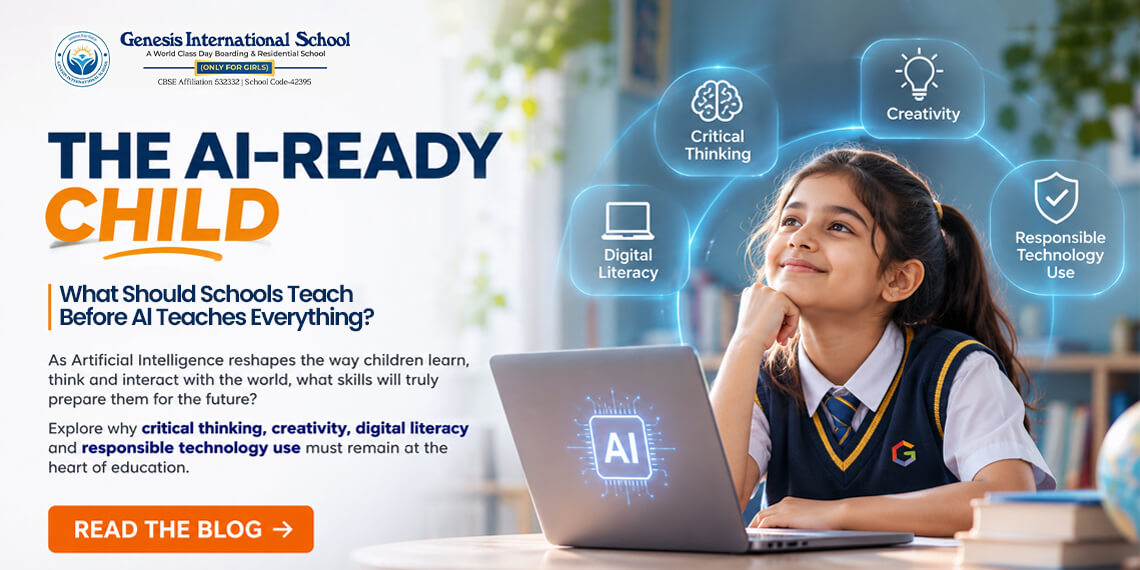
Development of artificial intelligence is influencing the process by which children acquire knowledge and learn. The Genesis International School values the significance of critical thinking, technology ethics, and creativity for the next generation.
With artificial intelligence being used more and more in education, communication and everyday life, a relevant question is arising for both schools and parents: How can kids get ready for life where technology would be able to explain ideas, generate content and solve increasingly complex problems?
In its turn, Genesis International School is drawing attention to the fact that children need to be prepared not just for using the technologies but for using them properly.
In connection with the increasing role of artificial intelligence in education, the problem of reconsideration of skills that the students should get and how to assess them is arising. AI can be utilised in the process of research, in explanations and for creativity. But, at the same time, students have to develop their skills of assessing the information, identifying its limitations, making their own decisions and taking responsibility for them.
According to UNESCO, there are four main aspects of teaching students about artificial intelligence. These are human-mindset, ethics of artificial intelligence, AI techniques and applications, and AI system design.
When it comes to AI readiness at the Genesis International School, there is a chance for us to drive home the importance of one key idea—technology should help improve education, not substitute the very essence of learning.
Moving Beyond Digital Literacy to AI Literacy
Being computer literate does not necessarily mean that children know about the operation of artificial intelligence. Learning about capabilities and limitations of the system—as well as understanding that some of its findings may be checked for accuracy and credibility—is very important for kids, especially taking into account their age and experience in using such technologies.
Literacy in AI implies comprehension of the fact that the artificial intelligence technology can provide valid answers, and, at the same time, it can produce invalid, incomplete or even false data. It is essential for the students to be aware of how to verify the data produced with the help of the artificial intelligence technology through credible sources of information and what questions to ask.
These issues can be covered in the curriculum with the help of discussions, demonstrations, research work and projects. Schools do not have to stick only to the independent discipline of artificial intelligence which is only related to technology experts. Artificial intelligence should be related to languages, sciences, mathematics, history and creativity.
Critical Thinking Must Come Before AI Dependence
Being independent in thought is possibly one of the most important skills to have if one is aware about AI. As students can now get an answer within seconds, the task of the education establishment goes beyond finding out some facts but evaluating if the information is right and makes sense.
Education establishments can help students to develop their critical thinking abilities in asking for reasons, considering evidence, comparing views and drawing conclusions. The teachers may also ask their students to analyse mistakes made by AI, prove their statements using valid resources and justify which solutions are better than others.
All these efforts help students become active participants and not just recipients of generated answers.
The aim here is not to limit the use of AI, but rather to make sure that students will remain in charge of their thoughts. If children understand the concept prior to using any technological tools to find it out, they will be able to see mistakes and make the right decision.
Ethics, Privacy and Responsible Technology Use
In addition, preparing children for a future of technology will involve educating them on how to use technology responsibly. It should also cover privacy, consent, misinformation, bias, intellectual honesty and the implications of sharing one's personal information on a technological platform.
Children have to be made aware of why certain personal information should not be provided to unknown technological platforms, why AI-generated information needs to be verified and why presenting AI-generated information as their own can jeopardise their academic integrity.
Age-related guidelines should be appropriate. In schools and at home, the suitability of digital technology, age restrictions, privacy issues, and supervision should be taken into consideration when it comes to different age groups.
The UNESCO guidance on generative AI in education and research supports a human-centred approach to the matter which focuses on data privacy, inclusion, safety and meaningful education. These aspects are worth taking into consideration when schools create policies for the integration of AI in learning spaces.
Educating children about responsible technology usage is essential since it allows schools to educate children about digital capability along with accountability.
Creativity, Communication and the Human Advantage
Even if AI is capable of writing texts, creating images, presenting ideas and concepts, there is still a need for the development of personal opinions and perspectives in students.
Creative writing, arts, music, drama, debating and other similar forms of activities give children an opportunity to experiment, to voice their thoughts and to get new experience and thus formulate ideas that are based on what they see and understand.
It is also vital to develop the skills of communicating with other people and working together with them as students should be able to defend their choices and opinions, hear others out and find common ground.
At Genesis International School we pay much attention to the overall educational conversation about the importance of developing such skills as creativity, empathy, communication and personal judgment as they will be helpful in situations when there is no technical solution.
Teachers Remain Central to AI-Ready Education
With the coming in of AI technology, there should be no reason to undermine the importance of teachers. The emergence of AI creates more chances for teachers to direct their students towards understanding, inquiry, and proper learning.
Teachers will have to guide the students into understanding the difference between making use of AI in exploring an idea and making use of the same technology in completing an assignment without fully understanding the subject matter. In addition, there are various ways through which teachers will design their assignments based on reasoning, discussions, application, and ability to discuss one's work.
There could be a need for schools to evaluate their assignment designs and learning assessment methods. Oral presentations, supervised activities, projects demonstration, and reflections could help teachers to know what the learners really know.
Preparing Students for a Future That Will Keep Changing
There are no schools that are capable of predicting all future technologies and professions that will emerge during one's lifetime. However, there exists the possibility of preparing children for the transformations in their lives through gaining some certain skills.
Some of those skills include curiosity, persistence, critical thinking, digital literacy, creative approach and constant learning. One should strive to instill in students' minds the need to be curious about everything and experiment, making mistakes and asking for advice regarding the issues they do not understand.
Regarding Genesis International School, the debate concerning the necessity of preparing students for AI brings forward the importance of teaching children how to control the technology and its significance.
It is important to raise individuals who would be capable of interacting with the technology and keeping in mind the ability to think independently and determine whether or not to use the particular technology.
About Genesis International School
Genesis International School is an educational institute that aims to help the learners learn academically as well as develop in all other aspects. By adopting an education system that involves learning beyond the text books, Genesis International School tries to nurture the students' knowledge, confidence, responsibility and skills needed to cope with the challenges of the ever-changing world.
Media Contact
Genesis International School
The Genesis International School Sector-8, Urban Estate, Karnal 132001, Haryana